
Benton Projected and Actual Dates
A projected release date is a calculation or future decision point, while the actual date records a completed custody event. Missouri’s documented historical data uses the precise fields Sentence Minimum Release Date and Sentence Maximum Release Date. The minimum is calculated for an active sentence. The maximum is the maximum release or sentence-expiration date. Neither field, standing alone, proves the date on which someone walked out of a prison.
Scheduled versus actual: A minimum date, parole date, conditional-release date, maximum expiration, and final discharge describe different events. Confirm the completed event with the agency record.
A Benton County jail booking adds another distinction. The Sheriff’s public release view may show an exact date and clock time after the jail marks its custody released. That timestamp does not state a verified release reason and can also reflect transfer to MODOC or another custodian. The court order explains legal authority, while the jail movement record confirms local physical processing.
Choose the Benton Release System
Start with where the person is held and why. A pretrial detainee at the Benton County Detention Facility does not have a prison-style calculated date. Bond, dismissal, a later hearing, or another order may lead to release, but an unresolved hold can delay departure. A person serving a local sentence needs the sentencing judgment and the jail’s credit calculation. A person serving a Missouri prison sentence needs MODOC records and, where applicable, Parole Board information.
| Custody situation | Best date source | Main caution |
|---|---|---|
| Benton pretrial detention | Court docket plus jail confirmation | No fixed sentence-release date may exist |
| Benton local sentence | Judgment, jail credit calculation, and release record | No verified local good-time rule was found |
| Missouri prison sentence | MODOC active search, historical fields, institutional parole office | Calculated and eligibility dates are not guarantees |
| Active parole or conditional release | MODOC field record and supervising office | Prison release is not final discharge |
| Federal or immigration custody | BOP, ICE, federal court, or custodial agency | State and county tools do not cover those systems |
Note: A person can leave Benton County custody for another agency, so a local release timestamp does not always mark community release.
Find a Benton Projected Date
The quickest path changes with custody. Use the identifiers tied to that system, such as a Benton booking number, MODOC number, or court case number. Avoid relying on a name alone, especially when several charge rows or cases may apply.
- Identify whether the person is in Benton County jail, a Missouri prison, field supervision, federal custody, or immigration custody.
- For Benton jail custody, check the court case for bond, judgment, sentence, jail credit, or a release order.
- Call the Benton County Detention Facility or request its official record to learn whether credit has been applied and whether another hold exists.
- For a Missouri prisoner, open the MODOC Offender Web Search, complete the CAPTCHA, and match the active person by name, aliases, identifier, and case context.
- Ask the institutional caseworker or parole office about a specific active date. Do not assume every public result uses a universal “projected release” label.
- For history or final discharge, inspect all rows in the nightly FAK930 file or submit a Sunshine request by MODOC number, name, birth date, and case number.
- Confirm a completed county release through the Sheriff record, or a completed prison release or discharge through MODOC.
The Benton County released inmates search guide covers the full local record route, including the Sheriff’s short-term release display and the court cross-check. It is useful when the question changes from a future estimate to whether a release already occurred.
Missouri Release Date Fields
The MODOC public web search covers active offenders, including incarcerated people, probationers, and parolees. It expressly excludes discharged offenders. That means an active field-supervision result may remain after a person leaves prison, while a final discharge may cause the person to disappear from the active search. The landing page also carries a dynamic data-current timestamp.
MODOC’s nightly FAK930 file supplies a more durable historical path, with records reaching as early as 1974. It contains one row per charge rather than one row per person. The key public terms are Sentence Minimum Release Date, Sentence Maximum Release Date, and Completed Flag. A completed flag applies to that sentence or charge row. It does not prove that every row for the same MODOC ID has ended.
The MODOC Sunshine page explains the historical data and formal request route. An official request can ask for the release or discharge date and status, release type, institutional movement entry, supervision end, and other releasable data. No fixed fee or response time is published in the research, so do not plan around an assumed turnaround.
Note: Active Offender Web Search and historical FAK930 data answer different questions, so a missing active result requires a separate history check.
Benton Conditional Release Structure
RSMo 558.011 divides many Missouri terms of years into prison and conditional-release portions, subject to the law’s exclusions and details. For a sentence of nine years or less, conditional release is one-third of the term. For more than nine but no more than fifteen years, it is three years. For more than fifteen years, it is five years. The prison term is the remaining portion.
Conditional release is not final discharge. It places the person in the community under conditions and Division of Probation and Parole supervision. After a violation and required process, the Board may extend the conditional-release date, potentially as far as the full sentence. The original arithmetic is therefore not a guaranteed departure date.
The official RSMo 558.011 text shows the statutory sentence and conditional-release structure.
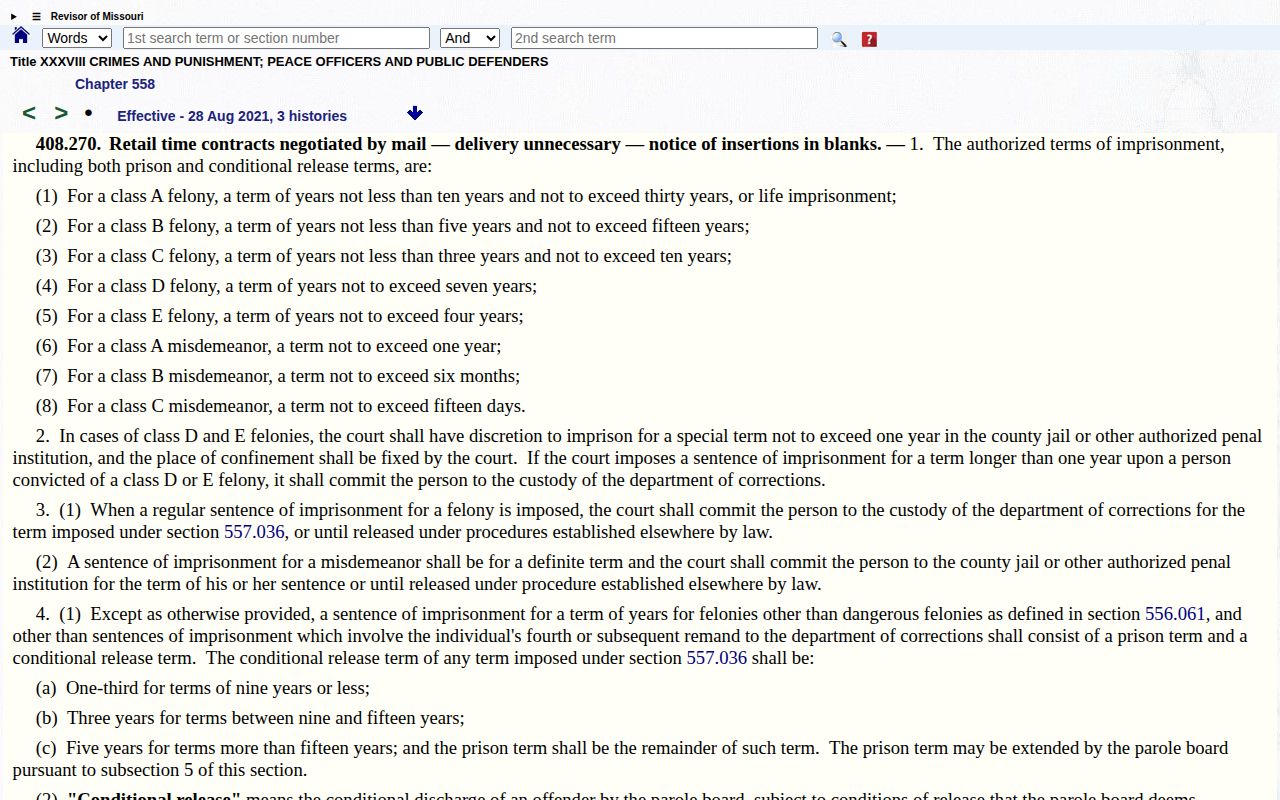
The statute supplies the framework, while MODOC and the Board apply the person’s sentence, offense, history, and later decisions.
Benton Prison Term Minimums
A broad claim that every Missouri prisoner serves 85 percent is wrong. RSMo 558.019 makes minimum prison terms depend on offense and commitment history. For non-dangerous felonies, one prior MODOC prison commitment can produce a 40-percent minimum, two can produce 50 percent, and three or more can produce 80 percent, subject to the statute and its age alternatives. A dangerous felony as defined by Missouri law generally requires 85 percent of the court sentence, or the age-based alternative stated in the provision.
For this calculation, life is treated as 30 years, and an aggregate term over 75 years is treated as 75. “Minimum prison term” means time before eligibility for parole, conditional release, or another early MODOC release. Eligibility does not compel the Board to grant release on that day.
The official minimum-term statute is the source for these offense-specific rules.
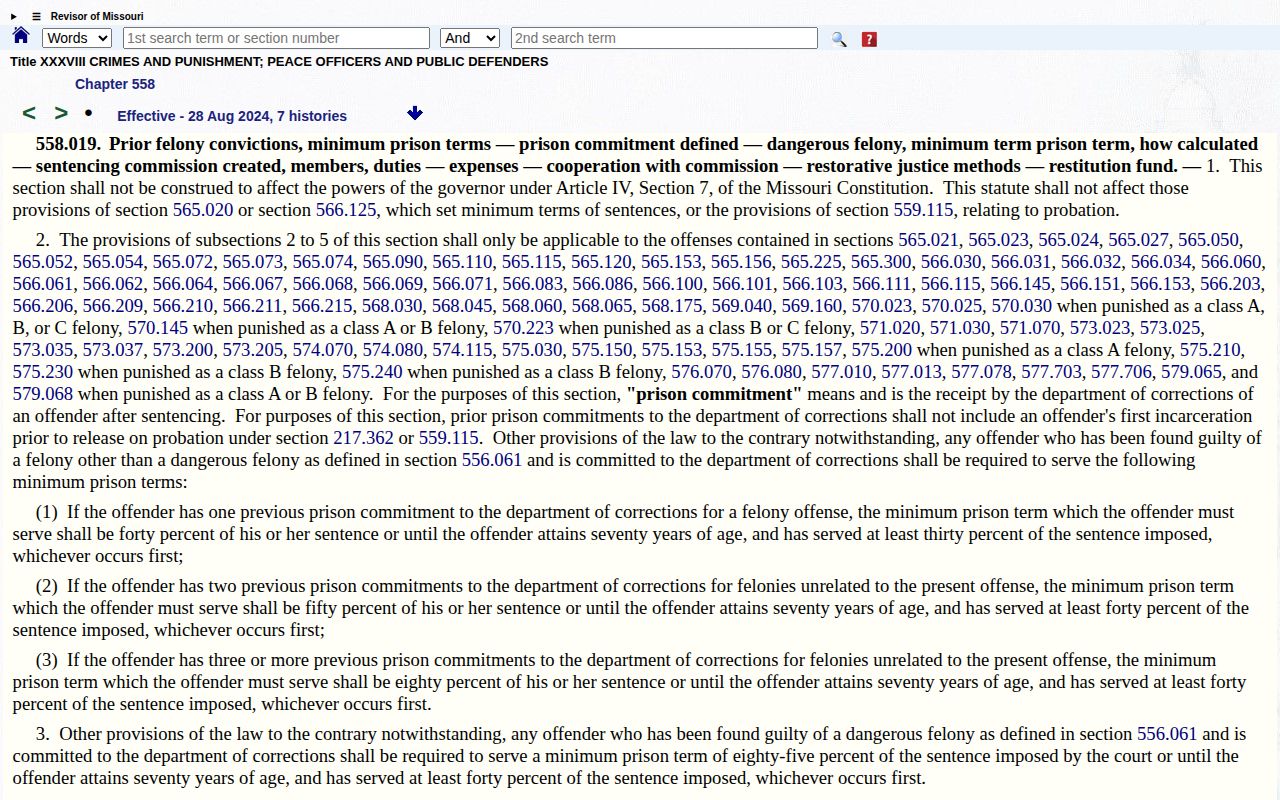
The statute is a limit and eligibility source, not a stand-alone calculator for a Benton County person’s actual release date.
Why Benton Release Dates Change
A future date can move because the record inputs or legal decisions change. Consecutive cases may be aggregated, a judgment can be amended, and the amount of jail or prison credit can be corrected. The Board’s guideline material is an aid rather than an entitlement, so a guideline range should never be reported as a promised release.
| Factor | Possible effect | Source to check |
|---|---|---|
| Consecutive sentences | Changes the combined minimum calculation, subject to statutory rules | Judgments, MODOC sentence data, RSMo 217.690 |
| Credit correction | Moves the calculated date when valid jail or prison credit changes | Jail, court, or MODOC sentence record |
| Amended court order | Changes the sentence or authority for custody | Case.net and certified court record |
| Board grant or denial | Sets, delays, or declines a discretionary release path | Institutional parole office or Board record |
| Conditional-release violation | May extend the conditional-release date after required process | Board and MODOC record |
| Institutional conduct or programs | May affect Board review or administrative date information | Institutional caseworker or parole office |
| Outside detainer or hold | Can prevent community release after one custodian ends control | Holding and receiving agencies |
RSMo 217.690 gives the Missouri Parole Board discretion and calls for assessment and a personal interview in the ordinary process. Consecutive-sentence minimums are aggregated subject to the statutory cap. A Board hearing or grant does not mean the person leaves immediately because legal and administrative conditions can remain.
Benton Historical Release Date Rows
Missouri’s historical Sunshine data creates a distinctive release-date trap. It can show a Sentence Minimum Release Date, Sentence Maximum Release Date, non-date sentinel values, and a Completed Flag on separate charge rows. One person may appear many times under the same MODOC ID. A researcher who reads one minimum date or one completed row in isolation can reach the wrong conclusion about final release.
Reconcile every row for the same person. Compare the MODOC identifier, court case, sentence date, location function, minimum and maximum fields, and completion flag. Then compare those rows with the court judgment and any formal MODOC response. A calculated minimum answers when a release path may become available under that row; it does not prove a Board grant, a completed prison exit, or the end of all supervision.
Historical-data rule: One completed charge row does not establish that every sentence ended. Review all rows tied to the same MODOC ID.
Note: Non-date sentinel values must be read from MODOC’s own field description rather than converted into an assumed calendar date.
Benton County Jail Dates
No Benton County local good-time computation policy or weekend-release rule was verified. Do not apply MODOC prison formulas to a sentence served at the Benton County Detention Facility. Use the sentencing judgment, ask the jail how credit was applied, and request the actual release record after the event. The detention line is 660-438-6135.
A person held before trial has a different date problem. The court may set or change bond, dismiss a case, enter judgment, or issue another order. Physical processing can occur later, and a detainer may keep the person from entering the community. The Sheriff’s 48 Hour Release can supply a public timestamp once Benton marks the person released, but the site warns that its online display is not the official record.
When the exact reason matters, ask for the booking and release date and time, release type if recorded, and movement or transfer entry. Check Case.net for the authorizing legal event. If the person may have gone to MODOC, an active institutional result is evidence against assuming a community release.
Note: Benton County publishes no verified local formula for good time, fixed release hours, or weekend processing, so confirm each case directly.
Confirm Benton Release Dates
Use a pending-release notification as an alert, not a final record. The Benton County VINE inmate check explains how MOVANS separates local jail, MODOC, and court providers. For local detention records, current registration uses SMS or email. An alert may lag, and a custody change can mean transfer rather than community release.
For an active Missouri prisoner, direct date questions to the institutional caseworker or parole office. For a county detainee, use the Benton jail and court. For final state discharge, use the historical file and formal Sunshine response because discharged people are excluded from the active search. Preserve the identifiers, source, and time of each answer so the records can be reconciled.
The strongest conclusion comes from consistent sources: the court judgment or order, the responsible custodian’s movement or release record, and any receiving-agency or supervision record. A single future date should be described as calculated, eligible, scheduled, presumptive, or maximum only when the source itself supports that term.